


Pool care may seem like a tedious chore, but it’s essential to protect the health of your family and keep your pool functioning properly. When maintenance is neglected, water quickly becomes cloudy or algae-filled, making swimming unsafe and unappealing.
In Perth, the challenge is even greater. Our hot summers and intense UV exposure speed up chlorine breakdown, leaving pools more vulnerable to algae blooms and bacteria.
Add in seasonal leaf fall, water restrictions, and WA’s naturally harder water, and it’s clear that a “set and forget” approach doesn’t work here. Neglecting upkeep not only risks safety but can also shorten the lifespan of expensive pool equipment.
The good news is that with the right approach, pool care doesn’t need to be overwhelming.
This guide gives you a step-by-step framework, from daily and weekly maintenance tasks to chemical balancing, cleaning equipment, and heating options, tailored to Perth’s climate.
Whether you prefer DIY methods or professional servicing, you’ll learn how to keep your pool safe, sparkling, and ready for use all year round.
Perth Pool Basics: The “3 C’s”
Every well-maintained swimming pool relies on three fundamentals: Circulation, Cleaning, and Chemistry. These “3 C’s” are the backbone of pool care, and skipping any of them is what leads to cloudy water, algae blooms, or even costly equipment damage.
Perth pool owners face extra pressure thanks to long, hot summers, high UV exposure, and hard water, making it even more important to get these basics right.
1. Circulation – Keeping Water Moving
Stagnant water is a breeding ground for bacteria and algae. Proper circulation ensures that chemicals spread evenly and debris moves toward the skimmer and filter.
Pump Runtime:
- Summer (Dec–Feb): Run your pool pump for 10–12 hours per day. Perth’s high UV quickly breaks down chlorine, so extended filtration helps maintain balance.
- Winter (Jun–Aug): You can reduce runtime to 6–8 hours per day while still preventing stagnation.
Filter Types:
- Sand filters: Popular in Perth for their durability and cost-effectiveness, but they require backwashing weekly in summer.
- Cartridge filters: Provide finer filtration but need to be hosed clean every 2–4 weeks.
- Diatomaceous Earth (DE) filters: Offer the clearest water, but are less common in WA due to higher maintenance needs.
Pro Tip: Angle your return jets slightly downwards and across the pool to create a circular flow, which minimizes dead spots where algae can form.
2. Cleaning – Removing What the Filter Misses
Even with strong circulation, some dirt, leaves, and oils cling to pool walls and floors. Manual or automatic cleaning is non-negotiable if you want to avoid unsightly algae rings and slippery surfaces.
- Skimming: Remove floating leaves, insects, and debris from the surface daily. Perth’s coastal winds and gum trees mean more debris than average suburban pools elsewhere.
- Brushing: Brush walls, steps, and corners weekly to stop algae from taking hold, especially in shaded areas.
- Vacuuming:
- Manual vacuuming: Once a week, especially after storms or heavy use.
- Automatic cleaners: Options like suction cleaners (Kreepy Krauly), pressure cleaners, or robotic cleaners reduce effort but still require occasional manual backup.
Maintenance Tip: Empty your skimmer and pump baskets weekly. Clogged baskets restrict circulation and force your pump to work harder, shortening its lifespan.
3. Chemistry – Balancing the Water
Water chemistry is where most Perth pool owners struggle. Get it right, and your pool stays crystal clear and safe to swim in. Get it wrong, and you’ll be fighting algae, scaling, or even corroded equipment.
- pH Levels: Aim for 7.2–7.6. Perth rain and dust can shift pH quickly. Low pH corrodes metal fittings and stings eyes; high pH leads to scaling and weakens chlorine.
- Chlorine: Keep free chlorine between 1.0–3.0 ppm. Because WA’s strong UV breaks down chlorine faster, many Perth pools rely on stabiliser (cyanuric acid) to slow this process.
- Total Alkalinity (TA): Target 80–120 ppm. TA acts as a buffer, helping your pH stay stable. Perth pools with low TA may see “pH bounce,” where pH levels swing dramatically.
- Calcium Hardness: Perth water is naturally harder than many parts of Australia. Aim for 200–400 ppm. Low calcium corrodes surfaces; high levels cause white scale buildup, especially on tiles and salt cells. A professional water test at least once a year is recommended to manage hardness properly.
Testing Routine: Use a 4-in-1 test kit weekly, or invest in an electronic tester for more accuracy. For calcium hardness, bring a water sample to a local Perth pool shop annually.
Why the “3 C’s” Matter in Perth
Competitor guides cover the “3 C’s” in general terms, but very few tailor advice to Perth’s unique challenges. By understanding how UV, water restrictions, and hard water affect circulation, cleaning, and chemistry, local pool owners can save money, extend equipment life, and enjoy sparkling water all year.
Daily, Weekly, Monthly, and Seasonal Pool Maintenance in Perth
Caring for your pool becomes much easier when you break tasks into a clear schedule. By following daily, weekly, monthly, and seasonal routines, you can keep your water balanced, equipment protected, and algae under control. This structured approach is especially important in Perth, where high UV, hot summers, and leaf-heavy autumns make pool upkeep more demanding.
Daily Pool Maintenance (Quick Wins)
A few minutes a day can prevent bigger problems later.
- Skim the surface to remove leaves, insects, and floating debris.
- Check that the pump and filtration system are running properly.
- Do a quick visual check for water clarity, unusual odours, or signs of algae.
- Confirm the water level is above the skimmer box intake.
Tips: Daily habits keep your pool looking fresh and make weekly care easier.
Weekly Pool Maintenance
Competitor guides agree that a weekly routine is the backbone of pool care. In Perth, weekly testing and cleaning are vital to counter UV and heat.
- Test and adjust water balance (pH 7.2–7.6, chlorine 1–3 ppm, alkalinity 80–120 ppm).
- Brush walls, steps, and corners to prevent algae buildup.
- Vacuum the pool floor (manual or automatic cleaner).
- Empty skimmer and pump baskets.
- Backwash or clean the filter if pressure has risen 8–10 psi above normal.
- Inspect equipment (pump, chlorinator, filter, heater) for leaks, noise, or wear.
Tips: A weekly routine keeps water safe and reduces the risk of expensive repairs.
Monthly Pool Maintenance
Monthly care goes deeper, addressing long-term water balance and equipment protection.
- Inspect all pool equipment for leaks, corrosion, or unusual sounds.
- Perform a shock treatment after storms, pool parties, or heavy use.
- Check and clean the waterline tiles to prevent scale or oily residue.
- Test stabiliser (cyanuric acid) levels to protect chlorine from WA’s intense UV.
- If using a salt chlorinator, inspect and clean the cell.
Tips: Monthly checks strengthen your pool’s defence against Perth’s tough climate.
Seasonal Pool Maintenance in Perth
Seasonal changes in Perth create unique demands on pool owners. Adjust your schedule with the weather to keep water clear year-round.
- Summer (Dec–Feb): Run the pump for 10–12 hours daily, increase chlorine, check stabiliser, and watch for rapid algae growth.
- Autumn (Mar–May): Expect more debris from falling leaves; skim daily, empty baskets more often, and monitor filter pressure.
- Winter (Jun–Aug): Reduce pump runtime to 6–8 hours, fit a pool cover, and keep circulation active enough to prevent stagnation.
- Spring (Sep–Nov): Deep clean, shock the pool, rebalance water chemistry, and prepare for heavy summer use.
Tips: Seasonal adjustments are essential to match Perth’s hot summers, leaf-heavy autumns, and mild winters.
Why This Calendar Works:
Breaking pool care into daily, weekly, monthly, and seasonal tasks simplifies upkeep and ensures nothing is missed. Competitors provide general routines, but this Perth-focused calendar takes into account WA’s climate, UV intensity, and seasonal debris, giving local pool owners practical guidance they can trust.
Maintenance of Swimming Pool: Step by Step
A swimming pool is a valuable part of any home, but it requires regular care to stay clean, safe, and enjoyable.
Without proper maintenance, water can quickly become cloudy, algae may grow, and equipment can wear out faster.
Basic upkeep ensures healthy water and extends the life of your pool.
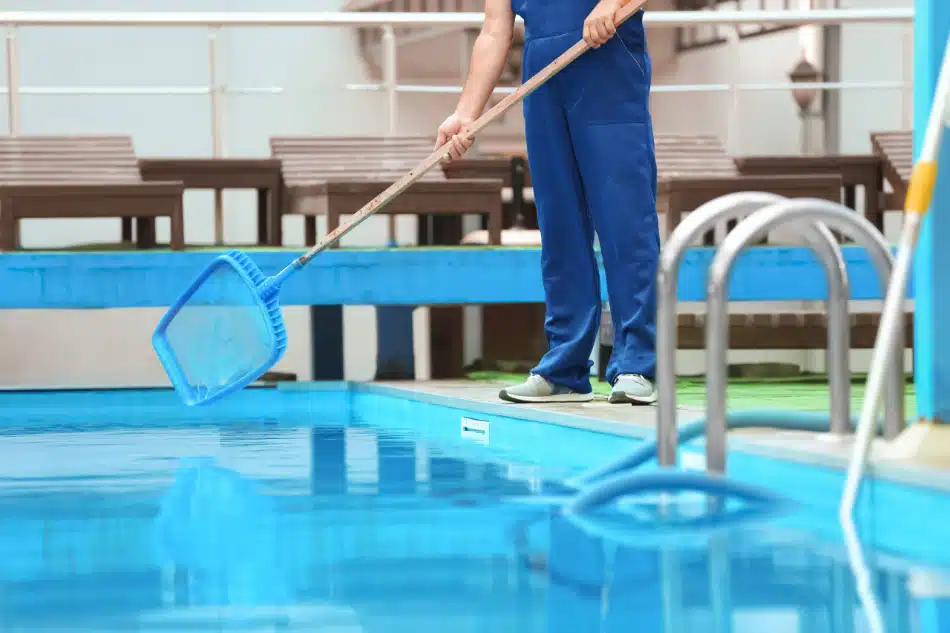
Step 1 – Pool Cleaning
Every swimming pool, regardless of how modern or well-designed it is, will naturally collect dirt, leaves, insects, pollen, and oils. If this debris is not regularly managed, it can make the water appear cloudy, encourage algae growth, and create unsafe swimming conditions.
For this reason, pool cleaning is the foundation of effective pool maintenance. The method you choose depends on factors such as the pool’s size, whether it is in-ground or above-ground, the power of the filtration system, the surrounding environment, and the available budget.
In Perth, pools are often exposed to windy conditions and native trees that drop significant amounts of debris. This means that homeowners typically deal with heavier cleaning requirements compared to other locations. A consistent and effective cleaning strategy is therefore essential.
1. DIY Cleaning (Hand Vacuum)
DIY cleaning is the oldest and most budget-friendly method of maintaining a pool. It requires manual effort but gives the homeowner complete control over the process.
How it works in detail:
- Attach the vacuum head to a telescopic pole and connect the hose.
- Submerge the hose to remove air and then connect it to the skimmer inlet to create suction.
- Brush pool walls, steps, and corners so that loosened dirt can be vacuumed up.
- Slowly move the vacuum head across the pool floor in overlapping passes.
- Monitor filter pressure during the process and backwash or clean the filter if necessary.
Time and frequency:
Cleaning by hand takes approximately 60 to 90 minutes per session and should be done at least once per week.
Advantages:
- Very low upfront cost, usually between $100 and $200 for equipment.
- Provides full control, allowing the user to target problem areas directly.
- Does not require additional power beyond the pool pump.
- Can deliver a thorough and reliable clean when performed carefully.
Disadvantages:
- Time-consuming and physically demanding, particularly for larger pools.
- Requires consistency; missing sessions can quickly lead to algae or cloudy water.
- Results depend heavily on the user’s technique, and rushing can leave debris behind.
Costs:
DIY pool cleaning with a hand vacuum costs around $100–$200 upfront, with minimal ongoing expenses beyond regular pump operation.
2. Hire a Pool Cleaner
For homeowners who prefer not to take on the task themselves, hiring a pool cleaner is a convenient and reliable option. Many pool owners in Perth choose professional services because they save time, ensure water chemistry is properly balanced, and provide regular inspections of pool equipment.
What a professional pool cleaner typically does:
- Skims the surface of the pool to remove floating debris.
- Brushes walls, steps, and tiles to prevent algae buildup.
- Vacuums the pool floor for a complete clean.
- Empties skimmer and pump baskets.
- Backwashes or cleans the filter when required.
- Tests water chemistry and adjusts chemicals to safe levels.
- Inspects pumps, filters, chlorinators, and heaters for signs of wear or leaks.
Advantages:
- Saves homeowners significant time and effort.
- Provides professional water testing to ensure balanced and safe conditions.
- Detects problems such as leaks or equipment issues early, preventing costly repairs.
- Delivers peace of mind, knowing the pool is maintained to professional standards.
Disadvantages:
- Ongoing service costs add up over time.
- Homeowners may still need to remove leaves or debris between scheduled visits.
- Less flexibility as the service depends on the cleaner’s schedule.
Costs:
- Regular cleaning services start at around $55 per visit.
- One-off intensive cleans range from $80 to $120 or more, depending on pool condition.
3. Use Automatic Pool Cleaners
Automatic pool cleaners are ideal for reducing the manual workload of pool maintenance. They cannot completely replace brushing or water chemistry checks, but they significantly reduce the time required for routine cleaning.
Choosing the right type of automatic cleaner depends on the pool size, debris load, and budget.
1. Suction Cleaners (e.g., Kreepy Krauly)
Suction cleaners are the most affordable and widely used option in Australia. They connect to the pool’s skimmer or suction port and move randomly across the pool floor while the pump is running.
- Pros: Affordable ($300–$600), easy to set up, widely available.
- Cons: Relies on the pool pump, which increases strain on the filtration system, and is less effective with large debris.
2. Pressure Cleaners
Pressure cleaners use water pressure from a return line or booster pump to power the unit and push debris into a collection bag. They are stronger than suction cleaners and are suited for pools that collect heavy debris such as gum, leaves, and twigs.
- Pros: Strong performance on large debris, reduces strain on the main filter, and works independently of the skimmer line.
- Cons: More expensive ($700–$1,200+), and some models require a booster pump ($300–$400 extra).
3. Robotic Cleaners
Robotic cleaners are the most advanced option. They operate independently of the pool’s pump and filter system, plugging into an external power source. They are equipped with onboard motors, filters, and brushes to scrub and vacuum the floor, walls, and waterline.
- Pros: Provides the most thorough cleaning, is energy-efficient, and reduces wear on the pool’s circulation system.
- Cons: Highest upfront cost ($1,200–$2,500+), and the filter cartridges must be rinsed after each cycle.

Step 2 – Pool Chemicals
Sanitation is essential to keep swimming pools safe and healthy. Without proper disinfection, bacteria and algae will thrive, especially in pools exposed to leaves, dust, pollen, and frequent swimmers.
In Australia, chlorine remains the most recommended and widely used method for domestic pools, though alternatives such as ozone, UV, bromine, and ionisation exist but are far less common.
The three main chlorination methods are manual chlorine dosing, salt chlorinators, and liquid chemical feeders. Each has its advantages, costs, and maintenance requirements.
1. Manual Chlorination
Manual chlorination is the most traditional and time-consuming method. It requires regular water testing and the physical addition of chlorine by hand.
How it works:
- Test the water to determine chlorine levels.
- Add the correct amount of liquid, granular, or tablet chlorine evenly around the pool.
- Repeat every 2 days for the average backyard pool.
Best suited for:
- Rental properties or temporary pool owners who do not want to invest in automated systems.
Pros:
- Very low upfront cost.
- Simple and effective when performed consistently.
Cons:
- Time-intensive and requires discipline.
- Easy to overdose or underdose if testing is not accurate.
- Less convenient than automated systems.
2. Salt Chlorinators
Salt chlorinators are the most widely used pool sanitation system in Australia. They convert dissolved salt into chlorine gas, which sanitises the water through the pool’s filtration system.
How it works:
- Add an initial dose of 4 kg of salt per 1,000 litres of pool water.
- The chlorinator converts the salt into chlorine gas automatically.
- Top up salt regularly due to losses from backwashing, splash-out, or overflow.
- Clean the chlorinator cell either manually (every fortnight) or rely on self-cleaning models.
Additional details:
- It can be installed on most pools, except above-ground pools with metal structures (risk of rusting).
- Units typically last around 5 years before replacement is needed.
- Chlorinator output is usually rated in grams per hour, and suppliers may provide equivalent measures compared to liquid or granular chlorine.
Pros:
- Convenient and low-maintenance compared to manual dosing.
- Provides consistent chlorine levels with minimal effort.
- Cost-effective to operate long term.
Cons:
- Higher initial investment than manual dosing.
- Salt cell requires cleaning and eventual replacement.
3. Liquid Chemical Feeders
Liquid chemical feeders are automated systems that dose chlorine (and sometimes acid) directly into the pool water through the filtration system.
How it works:
- Connect the unit to the pool’s filtration system.
- Set the dose and frequency (basic models).
- Advanced models monitor chlorine and pH continuously and automatically adjust chemical levels.
- Still perform manual tests weekly to verify accuracy.
Costs:
- Basic models start at around $600.
- Advanced sensor-based models: cost around $2,000 or more, with ongoing expenses for liquid chlorine and acid.
Pros:
- Highly convenient, particularly for busy households or heavily used pools.
- Advanced units automatically adjust dosing after events like heavy pool use.
- Helps maintain consistent water chemistry with less effort.
Cons:
- Higher upfront and ongoing chemical costs.
- More complex to install and maintain than salt chlorinators.

Step 3 – Balancing Water Chemistry
Testing and maintaining chemical balance is essential to keep pool water safe, clear, and comfortable for swimmers. It is recommended to check chlorine and pH levels at least once a week, or even daily if the pool is heavily used, while total alkalinity and calcium hardness can be monitored less frequently.
1. pH Balance
The pH level measures how acidic or alkaline the pool water is, on a scale from 0 to 14, with 7 being neutral. A well-balanced pool should maintain a pH between 7.0 and 7.8, with 7.4 considered the ideal. This range ensures the water is comfortable for swimmers and allows chlorine to disinfect effectively.
When the pH drops below 7.0 (acidic), the water can irritate eyes and skin, corrode pool equipment, and etch plaster surfaces. When it rises above 7.8 (alkaline), chlorine becomes less effective, scale begins to form on tiles and pipes, and the water may look dull or cloudy.
Many factors influence pH, including rainfall, topping up the pool with fresh water, the number of swimmers, and the amount of chlorine added.
How to adjust pH:
- To raise pH: Add soda ash (sodium carbonate).
- To lower pH: Add pool acid (muriatic acid or dry acid) carefully and circulate water before retesting.
Maintaining pH within the correct range is the first step in water balance, as other parameters often depend on it.
2. Total Alkalinity (TA)
Total Alkalinity measures the concentration of alkaline substances in pool water, usually in parts per million (ppm). The recommended range for Australian pools is 60–200 ppm. TA acts as a buffer, preventing rapid swings in pH.
If alkalinity is too low, pH becomes unstable and can fluctuate wildly, a condition known as “pH bounce.” This can damage pool surfaces, corrode equipment, and make the water uncomfortable for swimmers.
If alkalinity is too high, the water becomes resistant to pH changes, making it difficult to adjust. High TA can also cause cloudy water and scale deposits on surfaces and filters.
How to adjust TA:
- To increase TA: Add sodium bicarbonate (buffer) in measured doses.
- To decrease TA: Add acid, but this will also affect pH, so adjustments should be done gradually and retested carefully.
Stable alkalinity ensures that the pH remains steady and easier to manage.
3. Calcium Hardness (CH)
Calcium Hardness refers to the amount of dissolved calcium in the water. Balanced calcium levels protect both the pool structure and equipment. If levels are too low, water becomes aggressive and will leach calcium from pool plaster, tile grout, and even metal fittings, leading to corrosion and long-term damage.
If levels are too high, the water becomes “hard,” resulting in calcium scale on tiles, cloudy water, and reduced efficiency of heaters and filters.
The correct calcium hardness level depends on your local water supply. In Perth, where hard water is common, monitoring calcium hardness is particularly important to prevent scaling.
Because most domestic pool testing kits do not measure calcium hardness, it is best to take a sample to a professional pool shop for analysis once a year, or more often if you use calcium-based sanitizers such as calcium hypochlorite.
How to adjust CH:
- To increase calcium hardness: Add calcium chloride to the pool water.
- To reduce calcium hardness, partially drain the pool and refill with fresh water, as there is no direct chemical reducer.
If calcium hardness is high, keeping the pH at the lower end of the recommended range can help reduce scaling.
4. Testing Methods
Testing water regularly is the only way to maintain a proper balance.
- Basic 4-in-1 test kits: These are the standard option for homeowners, allowing measurement of chlorine, pH, total alkalinity, and acid demand.
- Electronic strip testers: These provide faster and often more precise results but are more expensive than traditional kits.
- Pool shop testing: Professional analysis is required to measure calcium hardness accurately. This should be done at least once per year or more often if calcium-based sanitizers are used.

Step 4 – Pool Heating
Heating a swimming pool extends the swimming season and, in cooler climates, allows for comfortable year-round use. The recommended pool water temperature is around 25°C, which is warm enough for comfort but efficient enough for most heating systems to maintain.
Regardless of which heating method is chosen, using a solar or thermal pool blanket is highly recommended. These blankets trap heat overnight, reduce evaporation, and lower energy costs.
In some regions, government rebates are available for solar or thermal blankets, making them a cost-effective addition to any heating system.
The three most common heating options for pools are solar heating, gas heating, and electric heat pumps. Each comes with its own costs, benefits, and ideal usage scenarios.
1. Solar Heating
Solar heating is one of the most energy-efficient methods for pool heating, making it especially attractive in sunny climates like Perth. The system works by pumping pool water through rubber matting installed on the roof, where the sun’s energy heats the water before returning it to the pool.
For best performance, the roof matting should cover at least 80% of the pool’s surface area and be installed on a north- or west-facing roof to maximize sun exposure. While solar heating can effectively raise water temperatures during most of the year, it may struggle on cloudy days.
In warmer regions, solar systems can heat pool water by 17–20 degrees for up to 10 months of the year. A solar controller can also automate the system, maintaining a preset temperature. In tropical regions, the system can even be used in reverse to cool overheated water at night.
- Works by circulating water through sun-heated roof matting.
- Requires a large roof space with optimal orientation.
- Covers at least 80% of the pool surface area for efficiency.
- Highly cost-effective once installed, with minimal running costs.
- Installation cost starts around $5,000 for a 50,000 L pool.
- Performance is limited on cloudy or cooler days.
2. Gas Heating
Gas heating provides a fast and powerful way to warm pool water, making it ideal for pools that are only used occasionally but need quick heating.
A gas heater can raise pool temperature within 12–24 hours, making it perfect for weekend use or special events. A thermostat can also be set to maintain a consistent water temperature if desired.
While gas heating is effective, it is less energy-efficient than solar or heat pumps, and ongoing running costs depend on local gas prices. Gas systems are best suited for homeowners who want rapid heating or who use their pool intermittently.
- Uses natural gas to heat water directly.
- Can provide constant warmth or on-demand heating.
- Raises pool temperature in 12–24 hours.
- Installation costs start around $6,000 for an average-sized pool.
- Running costs vary significantly with local gas prices.
- Best suited for occasional or event-based pool use.
3. Electric Heat Pump
Heat pumps are highly efficient systems that work like an air conditioner or refrigerator in reverse. They extract heat from the surrounding air, transfer it into the water through a heat exchanger, and maintain a consistent pool temperature year-round.
Heat pumps are slower to heat compared to gas systems, usually taking 2–4 days to bring the water to the desired temperature, but once heated, they are very efficient at maintaining it. For Perth homeowners who want a stable, comfortable pool temperature with lower long-term energy use, heat pumps are an attractive choice.
However, they do require a significant upfront investment, with smaller units starting around $6,000 and larger units costing between $9,000–$10,000 for average-sized outdoor pools. Electricity costs should also be factored into ongoing expenses.
- Works like an air conditioner, transferring heat from the air into the pool water.
- Provides efficient, consistent heating year-round.
- Takes 2–4 days to heat a pool initially.
- Very energy-efficient once running.
- Smaller units cost around $6,000, while larger models cost $9,000–$10,000.
- Ongoing costs depend on electricity usage.
FAQs
To Sum Up
Regular pool care in Perth means keeping up with cleaning, maintaining balanced water chemistry, ensuring good circulation, and adjusting for seasonal changes. Consistent upkeep not only saves money on repairs but also keeps your pool safe and enjoyable.
Need expert help? Book a SPASA-accredited pool service in Perth with 1PoolCare today.

With over 20 years of industry experience, Adrian Mole is the founder of 1 Pool Care, a leading mobile pool service in Perth. Known for his expert knowledge and reliable service, Adrian delivers professional pool cleaning, equipment repairs, and water balancing across the metro area. Backed by SPASA accreditation, he’s committed to quality, convenience, and customer satisfaction.


Social Media