


To choose pool pump horsepower by calculating the flow needed for one to two daily turnovers, then matching a pump’s performance curve to your total dynamic head. Bigger HP is not automatically better. The right pool pump delivers the required litres per minute quietly and efficiently, with a little headroom for options such as solar heating, a spa jet loop or a blade-style water feature.
What does pool pump horsepower mean
Horsepower is the motor’s rated power, not a promise of flow. A swimming pool pump turns electrical power into water movement, and the litres per minute you get depend on both motor power and plumbing resistance. A compact, efficient motor on an optimised wet end can outperform an old, inefficient 1.5 hp unit on the same pool because it holds higher flow at real-world head pressure. If you want a quick refresher on common pump styles and where they fit, start with Types of Pool Pumps.
Horsepower vs service factor horsepower (SFHP)
Service Factor Horsepower equals the nameplate horsepower multiplied by the service factor, and it tells you the motor’s real continuous capability.
- Example: a 1.0 hp motor with a 1.5 service factor has SFHP = 1.5 hp.
- Two pumps that both claim “1.0 hp” can have different SFHP and different real output.
- When comparing replacement pumps, check SFHP and the actual pump curve at your expected total dynamic head, not just the sticker on the motor.
For modern variable speed pumps, SFHP still exists, but you choose the operating point by setting pump speed in RPM. Always read the performance curve for the wet end you are buying.

How to size a pump for pool volume
Start with how many litres your pool holds, then pick a flow rate that turns the water over once or twice per day.
- Calculate volume.
- Rectangular: length × width × average depth × 1,000 = litres per cubic metre.
- Example: 8 m × 4 m × 1.5 m average depth = 48 m³ = 48,000 L.
- Pick a turnover target. Many residential pools run well at 1 turnover/day in cool weather and 1.5–2 turnovers/day in summer.
- Convert to flow.
- 1 turnover over 8 hours: 48,000 L ÷ 480 minutes = 100 L/min.
- 1.5 turnovers: 72,000 L ÷ 480 minutes = 150 L/min.
These are planning flows. You will refine the RPM or select a different pump size once you account for plumbing system resistance and features.
What flow rate do I need for proper turnover
Target one to two turnovers per day and adjust by season, bather load and clarity goals. In Perth’s warm months, run closer to two turnovers for stable pool water quality. A clear weekly rhythm helps you hold the desired turnover rate without guesswork. For simple routines that keep any pool on track, see How Often Should a Pool Be Serviced?.
Do variable-speed pumps replace the need to pick a specific HP
No. Variable speed models give flexibility, but you still need enough top-end power to hit your required flow at peak head. The beauty of variable speed pumps is running long, quiet low-RPM cycles for energy efficiency and then stepping up to higher RPM for vacuuming, heating or spa use. Timers and controllers make this easy. If you already automate solar or want scheduled RPM changes for off-peak times, explore Best Swimming Pool Solar Controllers.
Does pipe size affect the pump size I need
Yes. Pipe diameter and run length set friction losses that the pump must overcome.
- Bigger pipe = less friction = more flow at the same RPM.
- Long, thin suction lines starve a pump and force higher RPM for the same turnover.
- Many older inground pools use 40 mm suction and return lines. Upgrading to 50–63 mm on major runs can cut head loss and allow a smaller motor to do the same job.
- Each elbow, tee, valve and union adds equivalent length. Shorten loops and use sweep elbows to reduce resistance.
In short, your pool pipes and fittings often limit performance more than “pump power.”
How features change pump sizing: spa jets, waterfalls, solar
Every feature adds a flow and head requirement that can change the pump choice.
- Spa jet loop. Typical jet nozzles need about 30–40 L/min per jet at moderate back pressure. A four-jet spa adds 120–160 L/min during spa use. Many owners run spa on a separate pump.
- Blade or rock waterfalls. A slim blade may look best at 80–120 L/min at 1–2 m static head plus friction. Aim for a dedicated valve and a higher RPM preset.
- Solar heating. Roof loops add static lift plus line loss. The pump must maintain the minimum flow rate through the collector area to avoid cooling the roof. You need extra headroom or a solar-rated booster. For efficient choices that suit Perth sun, see Best Swimming Pool Solar Heater Options.
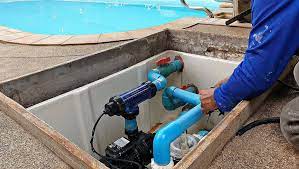
Is bigger horsepower always better
No. An oversized pump can create noise, high filter pressure, wasted energy and poor filtration.
- At high flow, a sand filter or cartridge filter can bypass fines and push debris through.
- A too-big motor on a small pad can cavitate, drawing air and wearing the seal.
- Oversized flow can overwhelm a heater’s maximum flow rate, triggering bypass or damage.
Right-sized flow held for longer is the path to clear, quiet and cheap circulation.
What is total dynamic head and why it matters
Total Dynamic Head (TDH) is the total resistance the pump must overcome, expressed in metres head.
TDH combines:
- Static head: height differences between water levels and equipment.
- Friction head: losses through pipes, elbows, tees, valves and the filter system.
- Equipment head: losses across heaters, chlorinators and check valves.
Why you care: you read the pump’s performance curve at your TDH to see the actual flow rate.
- Example: At 12 m head, a given wet end might produce 180 L/min at 2,850 RPM. At 18 m head, the same pump might only produce 120 L/min.
- Without TDH, “2 hp” vs “1 hp” tells you little about how many litres the pump moves in your pool system.
A simple way to estimate TDH is to measure filter pressure and suction vacuum, convert to metres, and add them. Your installer can do this during commissioning.
How filter type impacts pump choice
Filters impose different head losses and have different sweet spots for clarity.
- Sand or glass media filters handle moderate flow and are easy to backwash. High flow increases bed lift and can reduce capture of microscopic particles.
- Cartridge filters prefer steadier, lower flow for fine polish. Excess flow compresses pleats and shortens service life.
- DE or perlite filters capture very fine material but demand careful pressure management.
Clean filters are essential. Running a clogged filter forces higher RPM and energy use. For correct cleaning rhythms that keep head loss predictable, see Backwashing a Pool.
Single-speed vs two-speed vs variable-speed
Single-speed pumps run one flow whether you need it or not. Two-speed adds a low setting for daily economy. Variable-speed lets you dial any RPM to meet exact needs, which delivers the biggest energy savings and quiet operation across a day. Use the technology that fits your budget and your features, and remember that plumbing dictates how low you can go before you lose prime or skimming action. Full details on configurations live in Types of Pool Pumps, so we do not repeat them here.
Will higher HP increase energy costs
Usually, yes. More horsepower typically draws more power when run at full speed, and most owners then shorten run time to “save power,” which can reduce clarity. A right-sized or variable-speed unit run longer at lower RPM moves more water per kilowatt because pump power scales roughly with the cube of RPM. In practice:
- Dropping RPM from 2,850 to 2,100 can cut power by about 50 percent while still meeting turnover if you extend run time.
- Spreading flow over a longer window improves filtration and chemical contact time, which keeps the swimming pool clearer for less energy.
Your electricity bill reflects both energy consumption and run time. Program for clarity first, then trim.
Can a pump be too powerful and damage my filter or heater
Yes. Excess flow and pressure can exceed a heater’s internal bypass rating or deform filter elements.
- Cartridge filter: too much flow collapses pleats and can crack end caps.
- Sand filter: high velocity can blow media into the pool or push fines straight through.
- Heaters and chlorinators: exceeding maximum flow rate stresses manifolds and seals.
Keep filter gauge in the manufacturer’s normal zone. If pressure spikes after a pump upgrade, throttle the return with a valve or reduce RPM until the system is happy.
How loud are higher horsepower pumps
Bigger motors at high RPM create more mechanical and hydraulic noise.
- Noise rises with RPM, not just horsepower.
- Cavitation from restricted suction lines is loud and destructive.
- A variable speed unit run at lower RPM all day is usually quieter than a small single-speed run for a short, noisy burst.
Mount the base on a rubber pad, isolate pipes with flexible couplers and keep unions aligned to reduce resonance.
Typical lifespan by pump type
Expect 8–12 years for quality wet ends and 5–10 years for motors with routine care.
- Single-speed pumps: fewer electronics, simple to service, bearings and seals still wear.
- Variable-speed pumps: electronics like cool, dry, shaded locations. Heatsinks and fans need clean airflow.
- Seal life drops with heat, dryness and air leaks. Never run a powerful pump dry.
A tidy pad, correct ventilation and scheduled maintenance extend life across all types.
Worked example: pick a pump step by step
Scenario: A family pool in Perth, 8 m × 4 m × 1.6 m deep at the deep end, 1.2 m at the shallow, average depth 1.4 m. There is a small blade feature and a solar roof loop. Suction and return are 40 mm over 12 m with six elbows each way. Filter is a medium cartridge filter rated to 250 L/min.
1) Volume and turnover target
- Volume ≈ 8 × 4 × 1.4 = 44.8 m³ = 44,800 L.
- Target 1.5 turnovers/day in summer.
- Daily volume = 44,800 × 1.5 = 67,200 L.
- Run time plan = 10 hours/day to keep things quiet and efficient.
- Required average flow = 67,200 ÷ 600 = 112 L/min.
2) Features and peak flow
- Blade feature looks best at 90 L/min with about 1.5 m static head.
- Solar loop needs 120 L/min minimum when the controller calls for heat.
- We will set two presets:
- Circulation mode: 112–130 L/min for 10 hours.
- Solar mode: 120–140 L/min while solar is on.
- Feature mode: add 90 L/min only when the blade runs. This can share the higher RPM used for solar.
3) Estimate TDH
- 40 mm pipe over 12 m with fittings will likely produce 12–16 m head at 120–140 L/min on this equipment set, plus the filter and chlorinator loss. Round to 15 m TDH for circulation, 18–20 m for solar or feature use.
4) Read pump curves
- We shortlist a variable speed model with an efficient wet end rated near 1.0–1.5 hp SFHP, not a huge 2 hp.
- At 15 m head, the curve shows 130 L/min at 2,300 RPM.
- At 20 m head, the same pump delivers 115–120 L/min at roughly 2,600–2,700 RPM.
5) Check filter and heater limits
- Cartridge rating 250 L/min means our 130–140 L/min targets are safe.
- Heater and chlorinator have internal bypass up to 200–250 L/min, so we are within the maximum flow rate.
6) Program the schedule
- Winter: 7–8 hours at 2,000–2,200 RPM gives one turnover.
- Summer: 10 hours at 2,300 RPM for 130 L/min, then allow solar to call Feature/Solar mode at 2,600 RPM when needed.
- The controller supplies the power supply logic and timer blocks so RPMs move automatically. For test-and-tune confidence while you optimise RPM and flow, keep a reliable kit handy: Best Swimming Pool Test Kit.
7) Fine-tune with tests
- Log pressure gauge readings clean vs dirty. Clean the cartridge when pressure rises 20–25 percent.
- Watch return clarity and adjust water flow by 100–200 RPM increments until pool clean and skimming are consistent.
- Verify chemistry after schedule changes. A small shift in RPM can change pH aeration.
Outcome: A right-sized, mid-range variable-speed meets targets quietly, avoids the pitfalls of an oversized pool pump, keeps the filtration system happy and costs less to run than a high-horsepower single-speed blasting for a few minutes.
Choosing for different pool types and layouts
Round above ground pool
- Shorter runs and lower TDH mean a smaller motor often suffices. Many ground pools are happy with compact variable-speed units or efficient single-speeds that hit minimum flow rate for turnover and skimming.
Small inground pools
- Plumbing can be restrictive if built with narrow lines. Favour efficient wet ends and larger pipe where possible. The “smaller pump for longer” approach improves clarity and cuts noise.
Larger pools
- Long pipe runs favour a bit more SFHP or larger pipe to hold flow at reasonable RPM. Pairing a modestly bigger wet end with energy efficient scheduling often beats a larger pump run short and fast.
Avoiding common sizing mistakes
- Do not size pump by horsepower alone. Use a curve plus TDH.
- Do not ignore filter limits. A powerful pump on a small cartridge shortens element life.
- Do not chase skimmer action with raw RPM. Improve weir doors, water level and suction line health first.
- Do not forget features. Add up flows for water features, solar and spa use so you do not starve any loop.
- Do not assume “pump big, run short.” That often raises energy costs, hurts cleaning efficiency and can degrade clarity.
Energy efficiency and the real cost to run
Most residential pools clear up with long, calm circulation. A variable speed set near the lowest RPM that still skims is the sweet spot for energy savings. Keep baskets empty, fix suction leaks and clean filters on time so you are not forced to increase RPM to mask poor hydraulics. The weighted energy factor used in some regions highlights this: slow, steady flow wins on bills and water quality.
How sizing links to heaters, chlorinators and cleaners
- Heaters have preferred flow windows. Overshooting adds noise and stress.
- Salt chlorinators need enough flow to close the switch and dissolve gas. Too little flow trips faults.
- Robotic or suction cleaners need steady hydraulics. For suction models, airtight suction is crucial, and a mid-range RPM preset usually outperforms short, hard bursts.
FAQs that help you decide quickly
Buying checklist for the right pool pump
Use these steps to match a pump to your pool the first time.
- Calculate volume in litres.
- Choose turnovers/day by season.
- Set run time that fits noise, tariff and clarity goals.
- Compute target flow in L/min.
- List features with their flows: spa, solar, blade, suction cleaner.
- Estimate TDH from pipe runs, fittings and equipment.
- Read pump curves at your TDH. Confirm your target flow and a small margin.
- Check filter and heater limits. Stay inside ratings.
- Pick variable speed if budget allows, then create presets for skim, heat and feature.
- Plan maintenance so pressure stays stable and the schedule remains efficient.
Final word
The right pool pump is the one that meets your turnover at your head pressure, with quiet operation and a clear path to lower running costs. Focus on litres per minute at TDH, not the biggest horsepower. Set realistic schedules, keep the pool filter clean, and your swimming pool will stay clear without a noisy, expensive motor doing all the heavy lifting.

With over 20 years of industry experience, Adrian Mole is the founder of 1 Pool Care, a leading mobile pool service in Perth. Known for his expert knowledge and reliable service, Adrian delivers professional pool cleaning, equipment repairs, and water balancing across the metro area. Backed by SPASA accreditation, he’s committed to quality, convenience, and customer satisfaction.


Social Media