
Public pools host hundreds or even thousands of swimmers each week, so they need a strict cleaning and maintenance schedule to keep water safe, clear, and comfortable. Therefore, it’s important to clean and test a public pool every day, deep clean and service filters at least once per week, and run a full chemistry review and filter deep clean monthly, with extra checks during peak load, hot weather, and after incidents. For facilities, engaging dedicated commercial cleaning support helps keep standards consistent.
This 2025 guide explains what to do daily, weekly, monthly, and seasonally, how to set chemical targets, and how to prevent costly problems before they start. You will also see how public pools differ from residential pools and who is responsible for each task.
Why does public pool cleaning matter?
Public pools face higher bather load, faster chemical consumption, and greater health risks than private pools. Sweat, body oils, sunscreen, dirt, and organic matter enter the water at a much higher rate. Without regular cleaning and a correct pool maintenance schedule, contaminants build up and cause cloudy water, algae growth, eye and skin irritation, and equipment strain that leads to costly repairs.
What regular cleaning protects
- Swimmer safety by keeping harmful bacteria under control
- Water clarity so lifeguards can see the pool floor
- Pool equipment by reducing load on the pool pump, pool filter, and heat exchangers
- Budgets by avoiding emergency treatments and unplanned shutdowns
How often should public pool water be tested?
Test and log free chlorine and pH at least twice per day when the pool is open. Many facilities test every 2 to 4 hours during peak use. Measure total alkalinity and calcium hardness weekly, and cyanuric acid monthly if used outdoors. Always follow local health department requirements for public pool testing and record keeping. If your team needs a primer on tools, see this guide to pool test kits.
Minimum testing cadence
- Free chlorine and pH: 2 to 4 times per day while open
- Combined chlorine: daily or when odour or irritation appears
- Total alkalinity and calcium hardness: weekly
- Cyanuric acid for outdoor pools: monthly, and keep within policy limits
What daily maintenance should you schedule?
Work through a set checklist every day to hold water quality and catch small problems early.
Daily tasks
- Test and balance: verify free chlorine, pH range, and total alkalinity sit in target. Dose sanitiser and adjust pH as needed.
- Check water clarity: confirm you can see the pool floor in all lanes and depths. Cloudiness signals filtration or chemical issues.
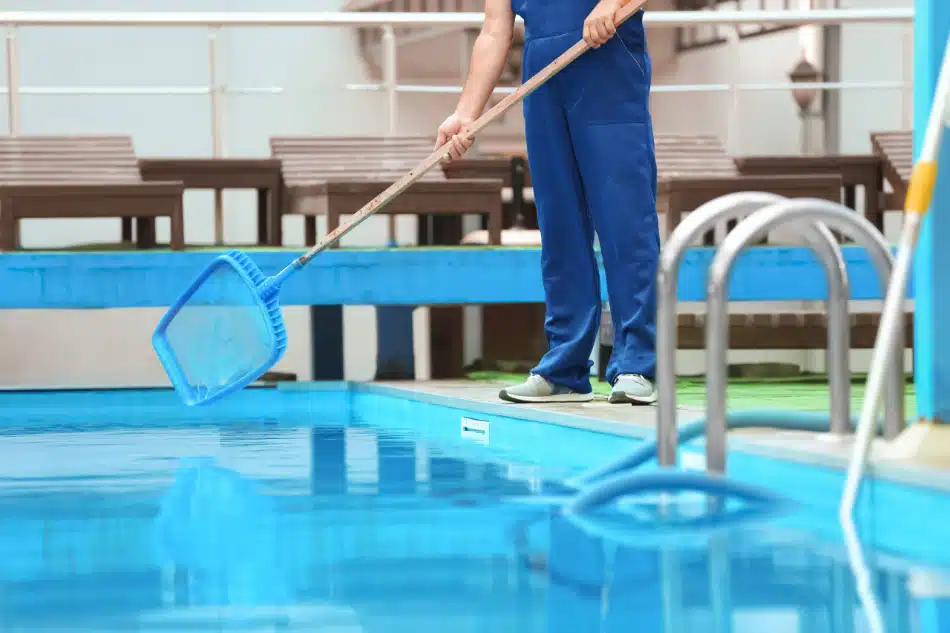
- Skim the surface: remove leaves and floating debris with a net before it sinks.
- Empty baskets: clear the skimmer basket and pump strainer for proper circulation.
- Brush walls and steps: brush tiles, ladders, corners, and the waterline to prevent biofilm.
- Vacuum the pool floor: use an automatic pool cleaner or manual vacuum to remove fine debris.
- Inspect the filtration system: confirm flow and pressure are normal for your filter type, whether sand filters, cartridge filters, or diatomaceous earth filters.
- Check safety equipment: inspect lifebuoys, reach poles, rails, and diving boards for damage.
- Monitor water level: keep water halfway up the skimmer box for reliable suction.
What weekly tasks keep a public pool stable?
Back up the daily routine with deeper cleaning and system checks.
Weekly tasks
- Backwash media filters: backwash sand and DE filters to restore flow and note the clean pressure.
- Clean cartridge filters: hose pleats top to bottom. Replace worn elements.
- Brush all surfaces: include lanes, ramps, benches, and gutters. Pay attention to low circulation zones.
- Vacuum thoroughly: add a slow manual vacuum pass in high traffic areas.
- Test calcium hardness: hold in the correct range for your surface to reduce scaling or erosion.
- Inspect for algae: treat early signs with shock and adjust chemistry before growth spreads.
- Lubricate seals: apply silicone grease to pump lid o rings and valve stems to prevent leaks.
What monthly and seasonal maintenance should you plan?
Schedule larger jobs each month and at the start of each swimming season.
Monthly tasks
- Run a full water analysis: free chlorine, combined chlorine, pH level, total alkalinity, calcium hardness, and cyanuric acid if used.
- Inspect filter media: check sand for clumping or channels, cartridges for tears, and DE grids for damage. Replace media when performance drops.
- Deep clean filters: use a filter cleaner to remove oils and scale deposits.
- Audit safety gear: confirm markings, depth signs, lighting, and alarms function as required.
- Assess pool blanket or cover: clean, check for damage, and repair straps to reduce evaporation and heat loss.
Seasonal tasks
- Service heating equipment: check electric heat pumps, gas heaters, and solar pool heating for proper operation before peak season.
- Verify circulation capacity: compare actual flow to design for lanes and features. Increase flow or run time if pressure rises or clarity dips during peak load.
- Train staff: refresh procedures for test and balance, backwashing, and incident response.
What chemical targets keep public pools safe?
Hold a consistently safe residual and stable pH so sanitiser can work. Always follow your state or territory health code. The numbers below are common operational targets for many commercial pools, but local rules control.
Typical operational ranges
- Free chlorine: 1.5 to 3.0 ppm for conventional chlorination. Raise for high load or warmer water.
- Combined chlorine: under 0.5 ppm. Shock or increase turnover if higher.
- pH levels: 7.2 to 7.6 for swimmer comfort and sanitiser efficiency.
- Total alkalinity: 80 to 120 ppm to buffer pH.
- Calcium hardness: 200 to 300 ppm for plaster and 150 to 250 ppm for fibreglass and vinyl.
- Cyanuric acid: outdoor pools only, keep within local limits. Many public indoor pools do not use stabiliser.
How often should a public pool be cleaned?
Clean and check the pool every day, backwash or clean filters at least once per week, and perform a full analysis and deep clean monthly. Frequency increases with bather load, water temperature, and weather. A busy summer day may require mid shift basket checks, additional skimming, and extra testing.
Quick frequency guide
- Daily: test and balance, skim, empty baskets, brush hot spots, vacuum, verify clarity, and log readings
- Twice weekly: review equipment, inspect seals, and brush all surfaces
- Weekly: backwash or clean filters and test calcium hardness
- Monthly: run a complete analysis and deep clean filters and gutters
- Seasonally: service pumps, filters, heaters, and automatic pool cleaner systems
What happens if a public pool is not cleaned regularly?
Water quality falls and health risk rises. You will see cloudy water, strong odours from combined chlorine, slippery tiles, and irritated eyes and skin. Algae spreads on the pool walls and the pool floor, and the filtration system clogs faster. Ignoring maintenance triggers shutdowns, higher pool maintenance costs, and damage to the pool pump, filters, and heat exchangers.
Who is responsible for maintaining public pools?
Pool owners and operators are responsible for daily operation, record keeping, and timely maintenance. Most facilities use trained staff or a pool maintenance company to perform testing, cleaning, and equipment service. A well maintained pool meets health regulations and offers a safer experience for the community.
How often should public spa pools be cleaned?
Clean and test spa pools more frequently than standard pools. Hotter water and high bather load accelerate chemical consumption and biofilm growth, especially in a hotel resort environment.
Spa pool cadence
- Test and balance sanitiser and pH several times per day while open
- Drain and refill on a regular cycle set by bather load and code
- Brush and vacuum benches and steps daily
- Backwash or clean filters more often due to higher load
How often should filters be changed or serviced in public pools?
Service is ongoing and media replacement follows performance, not a calendar.
- Sand filters: backwash when pressure rises by 8 to 10 kPa above clean pressure. Replace sand when channels or clumps appear or when backwash intervals shorten significantly.
- Cartridge filters: hose pleats when flow drops or pressure rises. Replace elements that show tears, flattening, or swollen end caps.
- DE filters: backwash and recharge with fresh diatomaceous earth per manufacturer guidance. Inspect and service grids during seasonal shutdowns.
What is the difference between public pool cleaning and servicing?
Cleaning removes debris and restores water quality. Servicing keeps equipment reliable. Cleaning includes skimming, brushing, vacuuming, and test and balance. Servicing includes backwashing, filter media change, pump seal replacement, valve maintenance, controller calibration, and heater checks. Both are required for a well maintained pool.
How do you prevent problems before they start?
Adopt a preventative maintenance plan and monitor trends.
Prevention checklist
- Track test results and equipment pressure so you see changes early
- Calibrate test kits and controllers on a set schedule
- Train staff on correct mixing of pool chemicals and incident response
- Keep spare parts such as pump lid o rings, baskets, and pressure gauges
- Use a pool blanket overnight where suitable to reduce evaporation and heat loss
- Increase run time and testing during peak swimming season and after storms
Special cleaning situations you should plan for
Prepare written procedures for events that add heavy load or unusual contaminants.
- Faecal incident: follow your health department’s superchlorination and closure protocol
- Vomit or blood: clean and disinfect surfaces, superchlorinate, and log the incident
- Dust or smoke events: run continuous filtration, clean filters, and increase testing
Quick reference: daily and weekly public pool cleaning
- Test and balance free chlorine and pH two to four times per day
- Skim, empty baskets, and brush hot spots daily
- Vacuum the pool floor and check clarity every day
- Backwash sand filters or clean cartridges weekly or sooner if pressure rises
- Perform a full chemistry analysis monthly and deep clean filters
- Service pumps, filters, and heaters before the swimming season
Bottom line
A public pool stays safe and clear when you follow a consistent pool maintenance schedule that assigns daily, weekly, monthly, and seasonal tasks and holds chemical balance within target. Test often, log results, clean filters when pressure dictates, and fix small issues before they become shutdowns. With correct maintenance, your swimming pool water will stay clear, your filtration system will run at optimal performance, and your community will enjoy a reliable, healthy place to swim.





Social Media